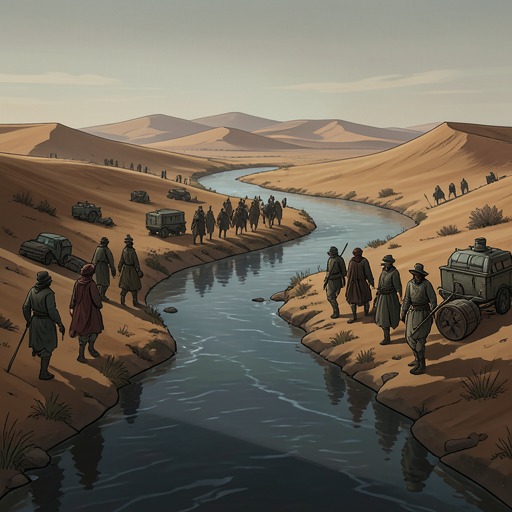
Pilgrimage down the River Iss
A Princess of MarsThe Pilgrimage down the River Iss is the voluntary final journey that Martians undertake at about a thousand years of age. Its solemn, irreversible passage toward an unknown destination contrasts with the much more frequent violent deaths that shape life on Mars, making the journey both a customary ending and a measure of the planet’s severe social order.
Age and the Journey
Martians show little visible change after reaching maturity at about forty, and, in the narrator’s account, no signs of extreme age are apparent. At around a thousand years, they voluntarily set out down the River Iss. The river leads toward a destination no living Martian knows; no one has returned, and a traveler who did return would not be allowed to live. The journey is therefore described not as a voyage with a known arrival, but as a final departure from which return is forbidden.
The river’s course gives the custom its distinct boundary. Dejah Thoris explains that it empties into the lost sea of Korus in the valley Dor, where a different language is supposedly spoken. She knows no record, beyond ancestral legends, of a Barsoomian returning upriver from the shores of Korus. Her account makes the pilgrimage’s destination part of a larger geography of mystery, while preserving the central fact that the travelers’ fate is not known to those who remain.
A Rare End Among Violent Deaths
The pilgrimage is uncommon beside the deaths that occur through ordinary Martian life. The narrator estimates that only about one Martian in a thousand dies of sickness, while about twenty undertake the voluntary journey; the remaining 979 die violently, in duels, hunting, aviation, or war. Many children also fall prey to the great white apes of Mars. These figures place the pilgrimage within a society where death is frequent, but the deliberate departure of the aged remains exceptional.
Although the average Martian who survives to maturity lives about three hundred years, the narrator judges that lifespan would approach a thousand years without the many causes of violent death. He connects the acceptance of danger to the planet’s dwindling resources and to the advances in therapeutics and surgery that have extended life. In that setting, life is held lightly: dangerous pursuits and nearly continual warfare coexist with the possibility of extraordinary longevity. The pilgrimage marks the age at which an individual chooses to leave, but most Martians never reach it.
What the Custom Means to Those Who Remain
Sola invokes the River Iss as the final passage in a life of unrelenting conflict. In her protest against the treatment of Dejah Thoris, she describes Martians as warring from the breaking of the shell until they embrace the river’s dark, mysterious waters. She calls an early death fortunate against that continual bloodshed. Her words do not present the pilgrimage as a remedy that transforms Martian society; rather, they make its unknown destination a stark contrast to the violence of the life left behind.
The journey also appears in Dejah Thoris’s account of the limits of known Barsoomian experience. Her insistence that no one is recorded as returning from the valley of Dor underscores the pilgrimage’s finality and helps explain why the destination remains surrounded by legend. Together, these accounts frame the custom as voluntary but irrevocable: its meaning lies less in any disclosed afterlife than in the threshold it sets between a long possible lifespan and a returnless passage beyond the knowledge of the living.